
News
Breaches, threats, advisories and policy: Canadian cybersecurity news, as it happens.
Zoom patches critical Windows privilege escalation bug threatening Canadian hybrid workforces
Zoom Communications has released urgent patches for two severe vulnerabilities in Zoom Workplace for Windows, including a critical flaw rated 9.6 on the CVSS scale that allows unauthenticated remote attackers to escalate privileges over a network. Canadian enterprises, public sector agencies, and hybrid workers relying on the platform face immediate exposure unless endpoints are updated to version 7.1.8 or later.
Google issues emergency Chrome patch
Google has rushed out an emergency security update for Google Chrome to address a high-severity zero-day vulnerability actively exploited in the wild. Canadian IT and security teams are urged to apply the updates immediately to protect corporate networks and endpoints.
Hackers hit OpenSSH ‘SSHole’ flaw within hours: what Canadian Alpine Linux users need to do
Attackers began targeting an OpenSSH password bypass less than nine hours after its disclosure. Canadian organizations running SSH on Alpine Linux and other musl-based systems should patch, restart sshd and check their logs.
Critical Linux kernel TCP vulnerability exposes servers to remote code execution
Canadian systems administrators and cloud infrastructure operators face an urgent kernel update cycle following the disclosure of a critical remote memory corruption vulnerability within the Linux IPv4 TCP stack.
OpenBSD issues urgent advisory targeting OpenSSH vulnerabilities
Cybersecurity authorities have issued a fresh warning regarding OpenBSD systems, highlighting a newly cataloged security advisory designated as AV26-1130. The alert focuses on vulnerabilities impacting OpenSSH versions prior to 10.6p2, prompting system administrators worldwide to audit their network environments and expedite patching procedures.
PHP2Shell: active exploitation reports
Canadian cybersecurity engineering and incident response teams managing large-scale web application infrastructure are racing to address ongoing threat activity following reports of active exploitation targeting the PHP2Shell vulnerabilities (CVE-2026-109618 and CVE-2026-109619).
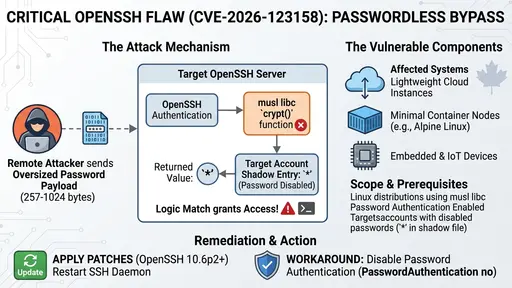
Critical OpenSSH authentication bypass exposes lightweight Linux infrastructure
Canadian systems administrators and security operations teams managing lightweight cloud infrastructure and container environments are facing an urgent emergency patch cycle following the disclosure of a critical authentication bypass vulnerability in OpenSSH
Debian and Ubuntu APT flaw lets MitM attackers swap verified packages and run code as root
A high-severity vulnerability discovered in the Advanced Packaging Tool (APT), the primary package management ecosystem powering Debian, Ubuntu, and their vast network of derivative Linux distributions, leaves unpatched systems susceptible to remote code execution with full administrative privileges.
Cisco advisory AV26-1127 warns of active SD-WAN and Secure Firewall zero-day exploitation
The advisory details an escalating threat environment where unauthenticated remote actors are exploiting flaws across Cisco Catalyst SD-WAN networks and Cisco Secure Firewall Remote Access SSL VPN services
GitLab issues urgent patch
Cybersecurity teams around the world are rushing to update their software deployment pipelines following the release of an emergency security patch by GitLab Inc. The vulnerability, designated as CVE-2026-97229, carries a maximum possible Common Vulnerability Scoring System rating of 10.0 out of 10
Broccoli2Shell: critical Brotli flaw now exploited in the wild
Days after PHP2Shell, defenders are facing a second critical flaw in a building block of the modern web. The Canadian Centre for Cyber Security has issued alert AL26-027 for CVE-2026-111497, an out-of-bounds write in the Google Brotli decoder nicknamed "Broccoli2Shell." On Oct. 27 the U.S. Cybersecurity and Infrastructure Security Agency (CISA) added the bug to its Known Exploited Vulnerabilities catalogue, which means attackers are already using it.
Lessons from the PHP Zero-Day Outage
One of the most effective measures adopted during the response to the PHP2Shell vulnerabilities was the use of automated offline redirection. Rather than keeping vulnerable application servers connected to the public internet, government portals that had prepared static maintenance pages in advance were able to keep Canadians informed while their underlying systems remained safely disconnected. This approach allowed public institutions to communicate clearly, maintain public trust, and reduce the risk of exploitation during a rapidly evolving security incident.